See us at ILA Berlin 2026 : HALL A|500
Hermeus Picks Pratt Engine For Hypersonic Darkhorse
Products & Services
Home - Aviation Group Marketing
Aviation Week Network
120 data points on over 156,000 commercial and business aviation aircraft, including military transports. Discover the most trustworthy resource for the complete aircraft history, plus ad hoc reports, month-over-month trend analysis and details on expected deliveries through 2050.
Aerospace | Aviation Week Network
Aviation Week Network
https://aviationweek.com/themes/custom/particle/dist/app-drupal/assets/awn-logo.svg
People

Andrea Rossi Prudente
Aviation Week Network

Anthony Lim
Aviation Week Network
Sales director
Becca Balmes
Aviation Week Network
Belinda Tan
Aviation Week Network
Brian Everstine
Aviation Week Network
Editor

Eddie Krankowski
Aviation Week Network
Assistant Manager, Tradeshows
erving dockery
Aviation Week Network
Lisa Tan
Aviation Week Network
Senior Marketing Manager
Mark Thomas
Aviation Week Network
Description
COLORADO SPRINGS—Startup aircraft developer Hermeus has selected Pratt & Whitney's F100-229 military turbofan as the core element of the upscaled Chimera II turbine-based combined cycle (TBCC) engine in development for the Darkhorse hypersonic vehicle.
Hermeus will use a modified version of the 29,000-lb. thrust engine, which also equips the Boeing F-15 and Lockheed Martin F-16, to power the 45-ft.-long uncrewed aircraft from a standing start on the runway to around Mach 2.8. At this transition speed a ramjet will take over to accelerate the Darkhorse to a target velocity of Mach 5.
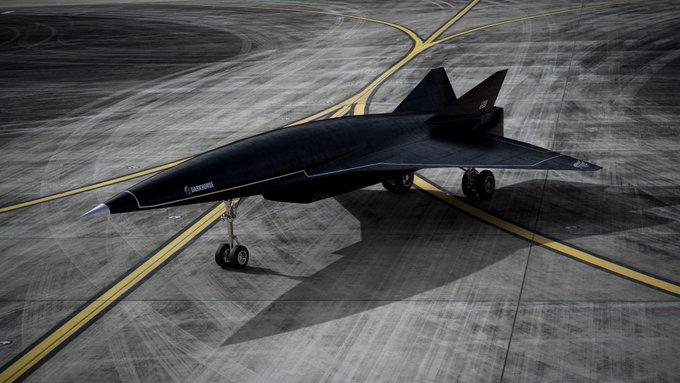
The Darkhorse is a delta-winged, twin-tailed derivative of the Quarterhorse, a proof-of-concept flight vehicle scheduled to fly in late 2023. This smaller demonstrator will be powered by the Chimera I TBCC which recently underwent turbojet-ramjet mode transition tests at the Notre Dame Turbomachinery Laboratory (NDTL) in South Bend, Indiana.
Flight tests of Darkhorse are expected in the mid-2020s. The production Darkhorse will have to undergo FAA airworthiness certification prior to providing commercial hypersonic testing service for the Defense Department and other customers. The Darkhorse is intended to pave the way for a 20-passenger civil hypersonic transport design dubbed the Halcyon.
The adoption of the F100 also strengthens bonds with Pratt & Whitney and parent company Raytheon which were first established in May when Raytheon Technologies announced a strategic investment in Hermeus through its corporate venture capital group, RTX Ventures. Hermeus founder and COO Skyler Shuford tells Aviation Week “the team at RTX Ventures have been extremely helpful in setting up conversations with multiple business units of Raytheon. The F100 is an ideal choice as the turbomachinery core for Darkhorse, but we're also exploring other potential partnerships as they make sense.”
The RTX Ventures investment, which was added to Hermeus' previously announced $100 million Series B financing round, has already directly supported work on the Quarterhorse demonstrator and will be used to accelerate development of the Darkhorse. The Atlanta-based aircraft developer adds that “securing an off-the-shelf turbine engine will save Hermeus billions of dollars in research and development costs and years of schedule.”
The F100 has previously been associated with high Mach projects, having been the proposed turbine engine for DARPA's Rascal (responsive access small cargo affordable launch) project in the mid-2000s. In this concept the engine, which was ground tested, would have been boosted with a water-oxygen mix through a system dubbed MIPCC (Mass Injection Pre-Compressor Cooling). Similar to the pre-cooler system the Chimera this cooled the superheated inlet air creating conditions closer to a lower Mach number. It also increases the density of the flow through the engine, as well as its volume, which means the engine produces more thrust the faster it goes.
Hermeus will use a modified version of the 29,000-lb. thrust engine, which also equips the Boeing F-15 and Lockheed Martin F-16, to power the 45-ft.-long uncrewed aircraft from a standing start on the runway to around Mach 2.8. At this transition speed a ramjet will take over to accelerate the Darkhorse to a target velocity of Mach 5.
The Darkhorse is a delta-winged, twin-tailed derivative of the Quarterhorse, a proof-of-concept flight vehicle scheduled to fly in late 2023. This smaller demonstrator will be powered by the Chimera I TBCC which recently underwent turbojet-ramjet mode transition tests at the Notre Dame Turbomachinery Laboratory (NDTL) in South Bend, Indiana.
Flight tests of Darkhorse are expected in the mid-2020s. The production Darkhorse will have to undergo FAA airworthiness certification prior to providing commercial hypersonic testing service for the Defense Department and other customers. The Darkhorse is intended to pave the way for a 20-passenger civil hypersonic transport design dubbed the Halcyon.
The adoption of the F100 also strengthens bonds with Pratt & Whitney and parent company Raytheon which were first established in May when Raytheon Technologies announced a strategic investment in Hermeus through its corporate venture capital group, RTX Ventures. Hermeus founder and COO Skyler Shuford tells Aviation Week “the team at RTX Ventures have been extremely helpful in setting up conversations with multiple business units of Raytheon. The F100 is an ideal choice as the turbomachinery core for Darkhorse, but we're also exploring other potential partnerships as they make sense.”
The RTX Ventures investment, which was added to Hermeus' previously announced $100 million Series B financing round, has already directly supported work on the Quarterhorse demonstrator and will be used to accelerate development of the Darkhorse. The Atlanta-based aircraft developer adds that “securing an off-the-shelf turbine engine will save Hermeus billions of dollars in research and development costs and years of schedule.”
The F100 has previously been associated with high Mach projects, having been the proposed turbine engine for DARPA's Rascal (responsive access small cargo affordable launch) project in the mid-2000s. In this concept the engine, which was ground tested, would have been boosted with a water-oxygen mix through a system dubbed MIPCC (Mass Injection Pre-Compressor Cooling). Similar to the pre-cooler system the Chimera this cooled the superheated inlet air creating conditions closer to a lower Mach number. It also increases the density of the flow through the engine, as well as its volume, which means the engine produces more thrust the faster it goes.