
ZeroAvia, MHIRJ Aviation Study Shows CRJ Hydrogen Retrofit Feasible
Products & Services
Home - Aviation Group Marketing
Aviation Week Network
120 data points on over 156,000 commercial and business aviation aircraft, including military transports. Discover the most trustworthy resource for the complete aircraft history, plus ad hoc reports, month-over-month trend analysis and details on expected deliveries through 2050.
Aerospace | Aviation Week Network
Aviation Week Network
https://aviationweek.com/themes/custom/particle/dist/app-drupal/assets/awn-logo.svg
People
Andrea Rossi Prudente
Aviation Week Network

Anthony Lim
Aviation Week Network
Sales director
Becca Balmes
Aviation Week Network
Belinda Tan
Aviation Week Network
Brian Everstine
Aviation Week Network
Editor

Eddie Krankowski
Aviation Week Network
Assistant Manager, Tradeshows
erving dockery
Aviation Week Network
Lisa Tan
Aviation Week Network
Senior Marketing Manager
Mark Thomas
Aviation Week Network
Description
LE BOURGET—Former Bombardier products are emerging as favored targets as startups seek to retrofit regional airliners with zero-emission hydrogen propulsion later this decade.
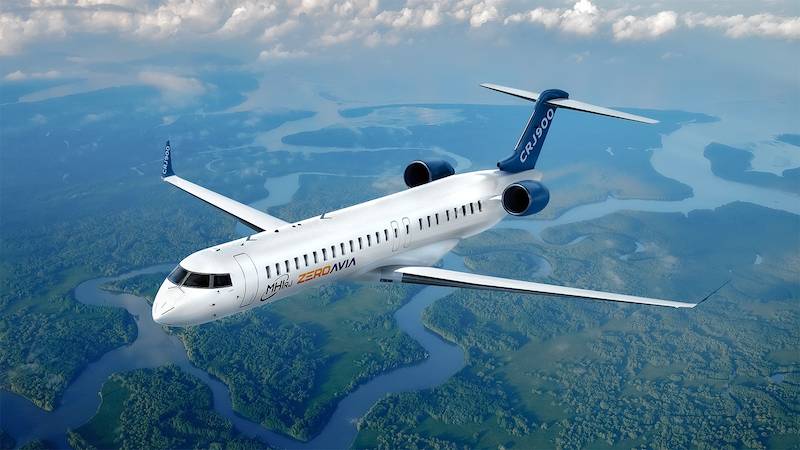
Propulsion developer ZeroAvia and Mitsubishi Heavy Industries Regional Jet (MHIRJ) Aviation—type-certificate holder for the Bombardier CRJ—have completed a technical study that has identified an initial entry point for a CRJ700 retrofit.
The year-long study has confirmed maximum takeoff weight, center of gravity and structural allowances for the CRJ700 modification and validated the retrofit approach for other in-service CRJ-series regional jets, such as the CRJ550 and CRJ900, ZeroAvia says.
Netherlands-based Conscious Aerospace, meanwhile, is appearing at Paris Air Show having signed a first-phase agreement with De Havilland Canada (DHC) to collaborate on the application of a hydrogen fuel-cell propulsion system to the Dash 8-300 regional turboprop, formerly produced by Bombardier.
The collaboration with Dash 8 type-certificate holder DHC will involve an assessment of retrofitting the 8-300 with Conscious Aerospace's 2-megawatt HAPSS 2100 hydrogen powertrain and storage system. The Dutch startup is aiming for service entry in 2028.
UK/U.S. startup ZeroAvia is already working with investor Alaska Airlines to retrofit a 76-seat Dash 8-400 to a demonstrator for its 2-megawatt-class ZA2000 fuel-cell powertrain. The company has established an engineering partnership with DHC to exchange data on the airframe, aiming for certification in 2027.
The hydrogen-electric CRJ would be fitted with two derivatives of the ZA2000 and could fly 60 passengers 560 nm, covering more than 80% of current CRJ flights. The engines would have increased-diameter geared ducted fans or open rotors to overcome the loss of turbine core thrust, ZeroAvia says.
The Phase 1 study with MHIRJ Aviation included a high-temperature proton exchange membrane fuel cell system with a specific power of 2.4 kW/kg. ZeroAvia has already demonstrated 2.5 kW/kg at the cell level and plans to deliver 3 kW/kg system-level specific power within two years.
Conscious Aerospace was established in September 2021 by consultancy Unified International. The HAPSS program is a public-private partnership involving 17 companies, Delft University of Technology and Netherlands aerospace center Royal NLR. The program is being supported by €100 million ($109 million) in government funding from the €383 million LIT (Aviation in Transition) program, company founder Michel van Ierland says.
Propulsion developer ZeroAvia and Mitsubishi Heavy Industries Regional Jet (MHIRJ) Aviation—type-certificate holder for the Bombardier CRJ—have completed a technical study that has identified an initial entry point for a CRJ700 retrofit.
The year-long study has confirmed maximum takeoff weight, center of gravity and structural allowances for the CRJ700 modification and validated the retrofit approach for other in-service CRJ-series regional jets, such as the CRJ550 and CRJ900, ZeroAvia says.
Netherlands-based Conscious Aerospace, meanwhile, is appearing at Paris Air Show having signed a first-phase agreement with De Havilland Canada (DHC) to collaborate on the application of a hydrogen fuel-cell propulsion system to the Dash 8-300 regional turboprop, formerly produced by Bombardier.
The collaboration with Dash 8 type-certificate holder DHC will involve an assessment of retrofitting the 8-300 with Conscious Aerospace's 2-megawatt HAPSS 2100 hydrogen powertrain and storage system. The Dutch startup is aiming for service entry in 2028.
UK/U.S. startup ZeroAvia is already working with investor Alaska Airlines to retrofit a 76-seat Dash 8-400 to a demonstrator for its 2-megawatt-class ZA2000 fuel-cell powertrain. The company has established an engineering partnership with DHC to exchange data on the airframe, aiming for certification in 2027.
The hydrogen-electric CRJ would be fitted with two derivatives of the ZA2000 and could fly 60 passengers 560 nm, covering more than 80% of current CRJ flights. The engines would have increased-diameter geared ducted fans or open rotors to overcome the loss of turbine core thrust, ZeroAvia says.
The Phase 1 study with MHIRJ Aviation included a high-temperature proton exchange membrane fuel cell system with a specific power of 2.4 kW/kg. ZeroAvia has already demonstrated 2.5 kW/kg at the cell level and plans to deliver 3 kW/kg system-level specific power within two years.
Conscious Aerospace was established in September 2021 by consultancy Unified International. The HAPSS program is a public-private partnership involving 17 companies, Delft University of Technology and Netherlands aerospace center Royal NLR. The program is being supported by €100 million ($109 million) in government funding from the €383 million LIT (Aviation in Transition) program, company founder Michel van Ierland says.


