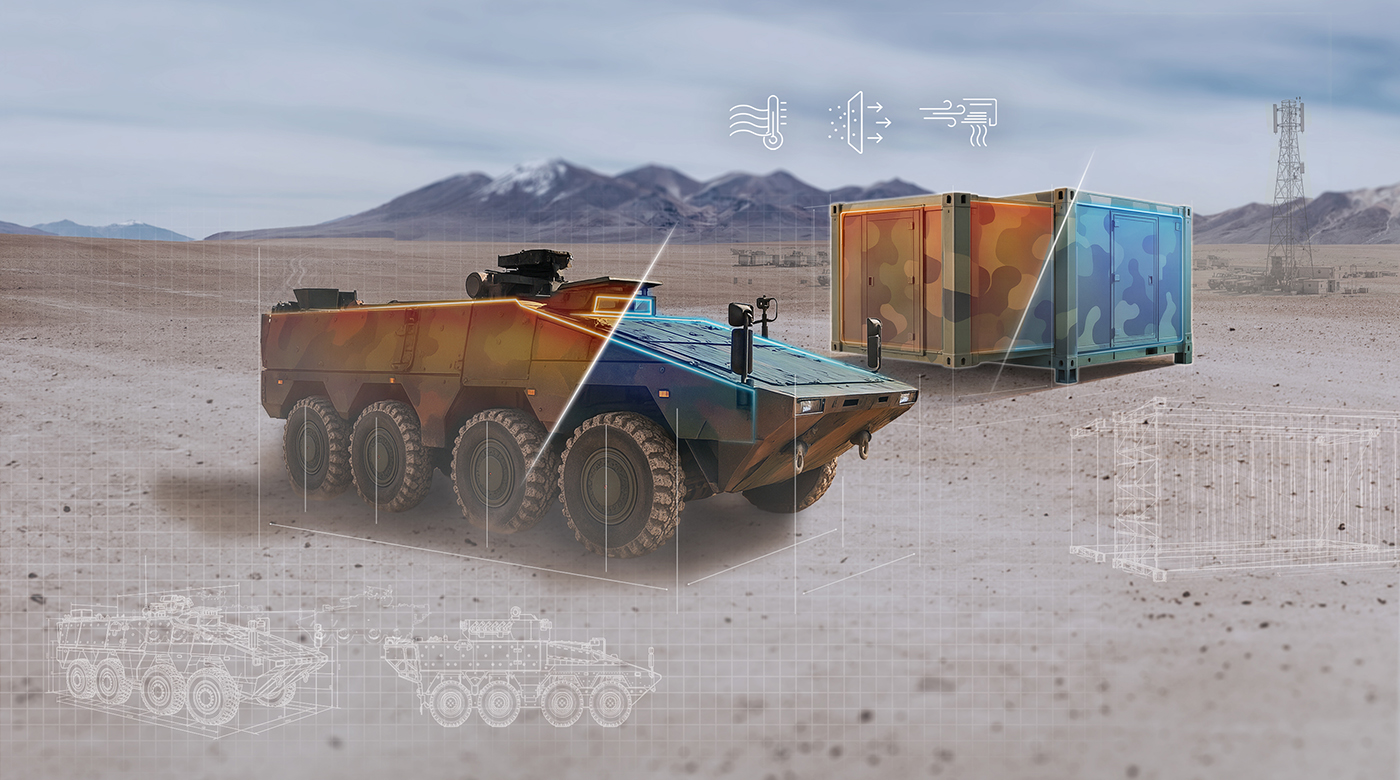

Engineered for extreme conditions
Advanced heating, cooling, and air filtration systems engineered for defense vehicles
WEBASTO ROOF & COMPONENTS SE
Stockdorf, Germany
Defense & Security
Products & Services
Thermo Pro 90 HDD
Webasto Roof & Components SE
Thermo Pro 90 HDD was specifically designed for steady and reliable heat in very demanding conditions. Features such as altitude adjustment (up to 4.500 m), artic start (down to – 46 °C), and infinitely adjustable heating output guarantee operational readiness in any environment. Moreover, all Thermo Pro 90 variants are characterized by low energy consumption and highly efficient fuel consumption.
Air Top Evo 40/55
Webasto Roof & Components SE
The Air Top Evo model offers greater comfort, safety, and heat output for defense vehicle, shelter and special equipment applications. The air heater heats up driver’s cabs, shelters, and cargo spaces quickly and efficiently. The new control system reduces energy consumption and noise significantly. The Air Top Evo 40/55 which is adapted to defence needs is a cost-effective retrofit solution since it is quick and simple to install.
Thermo Top Pro 50
Webasto Roof & Components SE
Thermo Top Pro 50 is lightweight and compact, considering its heating output of up to 5 kW. Moreover, it stands out for its low fuel consumption. Modern components such as the blower module and the coolant fluid pump, as well as a low partial load level of 2.5 kW, increase the efficiency of the heater and make it very quiet. Thermo Top Pro 50 heats the engine’s coolant circuit and ensures a comfortable vehicle interior - before driving, when stationary and during breaks.
UKG 12
Webasto Roof & Components SE
The UKG12 air-conditioner has been specially designed for the defense market to cool and heat air in various enclosed spaces (mobile and stationary, e.g., shelters). A constant temperature can be maintained and controlled automatically. The UKG12 is a monoblock air-conditioner designed for installation on the outer wall of a shelter. Optionally, the device can be retrofitted with a guide system that allows it to be pulled out. Designed and manufactured in accordance with defense requirements NO-06-A200, NO-06-A103.
Customized air-conditioning system
Webasto Roof & Components SE
Adapted to your needs: This air-conditioning system can be integrated into the roofs of heavy-duty vehicles or defense vehicles. It is specifically designed for steady and reliable performance in very demanding conditions.
Integrated air-conditioning system 12-16 kW
Webasto Roof & Components SE
These integrated air-conditioning systems from Webasto cool with an output of 12 to 16 kW. They create comfortable conditions in defense vehicles. As they can be installed under the dashboard, under the roof, in the vehicle liner or vertically in the rear panel, they are extremely flexible to use.
People
About
Mission-ready climate solutions for defense vehicles and shelters trusted by defense and security OEMs worldwide
As a global innovative systems partner to the mobility industry, Webasto is one of the 100 largest suppliers to the automotive sector worldwide. In development, manufacturing, and sales, the company focuses on roof systems on the one hand and on vehicle electrification on the other hand. The product range includes openable and fixed roofs, electric high-voltage heaters and batteries, as well as thermo management solutions.